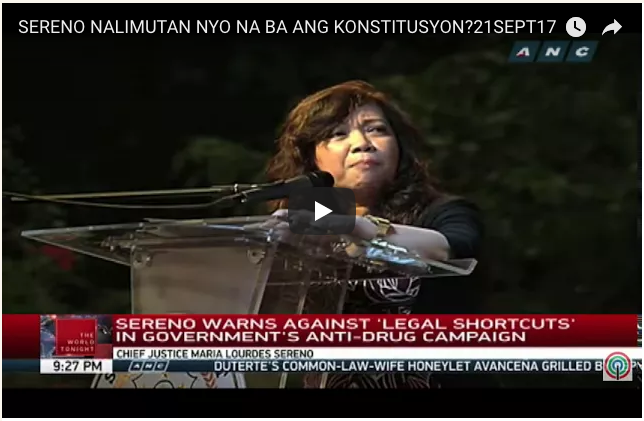
"Nakalimutan niyo na ba ang Konstitusyon? Nalimutan niyo na ba ang lakas ng pagkakaisa?" - Chief Justice Maria Lourdes Sereno #StandWithCJ
Excerpt from the speech at the unveiling of the Ka Pepe Diokno Memorial at the CHR.
Full text here:
KA PEPE: NASAAN ANG HUSTISYA
KUNG MALALIM ANG GABI AT MATINDI ANG PANGAMBA?
Nagnilay-nilay ako sa aking sasabihin kay Ka Pepe (Diokno) kung sakaling buhay siya ngayon. Ang una kong itatanong: "Ka Pepe, mukhang nalimutan na ng taumbayan kung ano ang nagawa mo para ibalik sa kabataan ang kalayaang mangarap. Ano ang sasabihin ko sa okasyon ng pagpapakilala sa publiko ng isang imahe mo na inukit sa bato?"
Kung buhay si Ka Pepe, marahil sasabihin niya: "Huwag mo nang ipagdiinan kung ano ang naging papel ko noong panahon ng diktaduryang Marcos. Mas mabuti kung ipaliliwanag mo na lang sa kabataan kung paano pangalagaan ang kanilang mga pangarap.
"Nguni’t Ka Pepe," ipinaalala ko, "Maraming hindi nakakaalam na pinapatay ang mga lider at ordinaryong kabataan noong panahon ng Martial Law. Lehitimo naman ang kanilang mga katanungan. Paano po ba gagamutin itong nangyayaring paglimot sa kahapon?
Malamang titingnan ako ni Ka Pepe.
Magbubuntung-hininga at uulitin ang sinabi niya noong 1972 mula sa piitan, sa liham niya sa kanyang anak. Nagtatanong si Popoy noon kung may silbi pa bang mag-abogasya samantalang nasa Martial Law naman ang bansa. Sinulat ni Ka Pepe: ”Maglalaho rin ang kahibangang ito. Ang rule of force ay yuyuko rin sa rule of law. Kakailanganin ng bayan ang kanyang mga dakilang abogado, inhinyero, ekonomista at mga tagapamahala. Tatawagin niya ang pinakamahuhusay sa kaniyang mga anak upang walisin ang mga basurang naiwan at maitaguyod muli ang pundasyon ng tunay na marangal na lipunang Pilipino.” Maihahalintulad natin ito sa isang paraphrased na kataga mula sa Lord of the Rings: Anupaman ay sisikat rin ang Haring Araw; at maglalaho rin ang kadiliman; at ang nakilala nating kagandahan at kabutihan ay manunumbalik.
"Nguni’t Ka Pepe," isasagot ko, "Noong napatalsik ng taong bayan ang diktaduryang Marcos sa tulong ng Poong Maykapal, nasabi mo na iyan. At inasahan ng lahat na uunlad nang mapayapa at tuloy-tuloy ang ating bansa. Sa halip, patuloy pa ring naghihikahos ang karamihan sa ating kababayan. Laganap pa rin ang mga dati na nating problema. Matindi ang pangamba ng mga ina at ama tuwing lumalalim ang gabi. Ibinubulong nila: Sana naman, huwag ang anak namin, huwag ang binatilyo naming pinakamamahal.
Ang sasabihin ni Ka Pepe: “Nalimutan niyo na ba ang Konstitusyon? Nalimutan niyo na ba ang lakas ng pagkakaisa? Balikan ninyo ang Pambungad o Preyambulo ng ating Konstitusyon. Ano ang sinasabi nito?
Kami, ang nakapangyayaring sambayanang Pilipino, nagmamanikluhod ng tulong ng Poong Maykapal, upang magtatag ng isang makatarungan at makataong lipunan, at magbuo ng isang Pamahalaang kakatawan sa aming mga mithiin at layunin, magsusulong ng ikabubuti ng mas nakararami, mangangalaga at magpapaunlad sa aming yaman, at magsisiguro para sa amin at sa mga susunod na salinlahi ng biyaya ng kalayaan at demokrasya, sa ilalim ng pananaig ng batas at ng pamamahalang nakasandig sa katotohanan, katarungan, kalayaan, pagmamahal, pagkakapantay-pantay, at kapayapaan, ay nilalagdaan at pinagtitibay itong Konstitusyon ng 1987.”
Ipagpapatuloy pa ni Ka Pepe: "Ipaliwanag mo, na kung buhay at bubuhayin lamang ang Konstitusyon sa puso ng bawat mamamayan at lingkod ng batas, wala sanang pangamba. Sabihin mo sa mga inang OFW, na kung susunod sa patakaran ang mga awtoridad, matutugunan ang kalagayan ng kabataang napagbintangan ng paglabag sa batas. Na lahat ng ina at ama, hindi sana natatakot pagsapit ng dilim.
"Sabihin mo na rin sa kabataan, na paalalahanan ang sambayanan: Ang paggalang sa karapatang pantao ay haligi ng Saligang Batas, ito ang tinutukoy ng Pambungad ng Konstitusyon na magdudulot ng tunay na katarungan at kapayapaan.
"Ang Konstitusyon ay banal na kasunduan ng taumbayan sa isa’t isa, at ng taumbayan sa gobyerno. Ang bawat pagsuway dito ay malaking kasalanan sa taumbayan.
"Sa ganitong konteksto, ipamulat mo sa lahat: Bawat kawani ng pamahalaan, ina at ama rin naman. Ipayo mo, na habang sila ay buong pagmamahal na nagmamasid sa kanilang mga paslit, uusigin sila ng kanilang konsyensya sa bawa’t utang nila sa taong bayan. Ganito ang mangyayari kung sila ay lalabag sa karapatang pantao, magnanakaw sa kaban ng bayan, o gagawa ng “shortcut” at isasantabi ang mga alituntunin ng kanilang trabaho. Ipaalala, mula sa pinakamataas hanggang sa pinakamababang lingkod ng bayad, na lahat sila ay nanumpang ipagtanggol ang karapatan ng bawat Pilipino."
"Ka Pepe," sabi ko, "Hindi po ba, ang alam ng taumbayan, automatic naman iyan, na naaalala naman ng lahat ng lingkod bayan na sumumpa silang itaguyod at sundin ang Konstitusyon at mga batas?"
"Bagama’t totoo yan," wika ni Ka Pepe, "Ang paglilok ng demokratikong lipunan ay gawain ng bawat Pilipino, hindi lamang ng gobyerno. Ang totoo, nasa balikat ng bawat mamamayan ang responsibilidad ng paggigiit sa pamahalaan na ipatupad nito ang batas. Kailan ba nagkaroon ng malawakang pagkilos upang pukpukin ang pulisya na tugisin ang mga kriminal, lalo na iyong malalaki? Kinausap niyo na ba ang mga prosekutor, yung mga piskal, na huwag ilaglag ang mga kaso ng mga big-time na sindikato? Inaral niyo na ba ang kailangang ebidensya upang mabilanggo nang habang buhay ang mga ito? Ilan na ang natanggal niyong mga pulis, prosekutor at huwes dahil sa katiwalian? At doon sa mga natumbok niyo nang mga big-time crime lords, ano ang mga sistema na ipinatutupad upang ang kanilang kasamaan ay masupil sa loob ng kulungan?
"Klaruhin mo: Dapat tugisin ang kriminalidad, at kung kailangang magbuwis ng buhay upang matupad ito, gawin ang kinakailangan; ngunit siguruhin na ang lahat ay ayon sa batas. Kung hindi, di-kalaunan ay ang mga masunurin sa batas na ang magiging biktima ng kapangyarihang walang takot sa Diyos at batas."
"Ka Pepe," tugon ko, "Baka lang naman po hindi mo nawawari, matagal masyado ang prosesong sinasabi mo. Ang sinasabi nga ng iba, hindi ba puwedeng shortcut na lang?"
At si Ka Pepe, malungkot na ipinaalala sa akin: Anak, maibabalik ba ang buhay?
Naalala ko ang napakarami na nating paglaban para sa kalayaan at sa karapatang pantao, kaya humirit pa ako: Ka Pepe, parang napapagod na pong mangarap ang karamihan, maaari po ba, manahimik na lang ang kabataan sa isang sulok?
My dear young people, Ka Pepe Diokno had served with all patriotism and courage. In the place and time that was given him, in a particular period in history, he had kept faith with the Filipino. The Commission on Human Rights is but one of his many legacies. A simple bust is not enough to remind people of the honor with which he waged his campaign for the return of democracy to our country. We must continue to relive his struggles, and articulate his thoughts.
The Supreme Court has already issued the Rules on the Writ of Amparo and Habeas Data, two human rights writs that seek to protect the citizens' rights to life, liberty, security, and privacy. Issued in 2007 and 2008 amidst a national conversation on whether there was hope that extra judicial killings would stop, the two writs gained recent prominence when the writ of amparo was issued by no less than the Supreme Court in two distinct cases.
In the first case, the Court issued the Writ of Amparo in favor of Efren Murillo, who had survived the anti-illegal drug operation conducted on Aug. 21, 2016 in Payatas, Quezon City, and the relatives of garbage collectors Marcello Daa, Jessie Cule, Raffy Gabo, and Anthony Comendo. In the second case, the Court issued the writ of Amparo in favor of Christina Macandog Gonzales, widow of Joselito Gonzales, who died of multiple gunshot wounds on July 5, 2016, during a reported encounter with policemen.
The Court issued a Temporary Protection Order barring the respondent policemen from entering the homes and workplaces of the families of the victims. The Court of Appeals, in record time taking just one hearing, made the protection order permanent and ordered the transfer of the police officers involved to an area outside Quezon City and Rizal. In the Gonzales case, the Supreme Court also issued a temporary protection order prohibiting respondent policemen from entering within a radius of one kilometer from the residence and work address of the petitioner in Antipolo City. The case is currently pending before the Court of Appeals.
There are at the same time pending proposals to strengthen the protection of the constitutional rights of citizens through additional judicial remedies.
In my Separate Opinion on the Martial Law cases, I urged citizens to ensure that the abuses of Marcos’ Martial Law not be repeated. I offered the proposition that the efforts by the military and the police this past decade to modernize and professionalize their ranks can also fall prey to a wayward implementation of martial law.
The thoughts of Ka Pepe, as well of those of our young people on what it means to have and to protect freedoms, must be memorialized, not only in works of stone, but on works that are etched in the hearts of our people. Works that stoke our dreams and fortify our visions for a lofty place in the community of nations. Works that strengthen the beating of our hearts, that increases the fervor with which we love our country and our fellowmen.
Balikan natin si Ka Pepe. Sabi niya: Alam mo, napapagod ang mga tao dahil nalimutan na nila ang kagandahan ng makatarungang pakikipaglalaban. Na ang mahahalagang bagay sa buhay, katulad ng mga matatayog na pangarap ng kabataan ay makakamtan lamang sa tuloy-tuloy na pagmamatyag na ang kabutihan at hindi kasamaan ang mananaig. Kung madalas lang nating ginugunita ang ating mga tagumpay sa kasaysayan, mapupuno muli ng pag-asa at pagmamahal sa bayan ang ating mga puso.
At sinariwa ko sa aking diwa ang buhay na inialay ni Ka Pepe, isang buhay na ngayo’y nagsisilbing isang ilaw sa ating bayan, isang napakabangong halimuyak ng kagitingan ng ating mga bayani.
I end by saying that cases in the Supreme Court can bring to light the discourse among our people. The conduct of oral arguments in some of these is usually the time when our justices can have their turn to ask probing questions of the parties. The Constitution remains the Judiciary’s North Star, guiding us as we, through our decisions, in our own way help steer the course of our nation’s history. May this light not be dimmed, may Ka Pepe have reason to smile.
Magandang hapon po sa inyong lahat.

CADET ALVIN JEFF CUDIA
 IN THIS PARTICULAR CASE CJ SERENO UPHELD THE HONOR CODE OF THE PMA OVER THE CONSTITUTION CONTRARY TO THE RECOMMENDATION BY THE COMMISSION OF HUMAN RIGHTS
|

Tuesday, September 26, 2017
COMICAL DISPLAY OF IRONY BY CJ SERENO_KA PEPE, NASAAN ANG HUSTISYA, KUNG MALALIM ANG GABI AT MATINDI ANG PANGAMBA?


304TH PERSUASIVE APPEAL_26SEPT17_TO THE SCP JUSTICES: YOUR HONORS , YOU INSTITUTIONALIZED THE CULTURE OF IMPUNITY
   
PUBLIC LIVES
The production of impunity
The word “impunity” simply means “without punishment,” or exempted from penalty—in reference to acts that normally require accountability and punishment. In the vocabulary of human rights advocacy, however, the term has a more textured meaning, reflecting the complex challenges that human rights activists have had to face over the years in societies wracked by
Drawing from her extensive work on the culture and politics of human rights activism in Colombia, anthropologist Winifred Tate offers the following definition: “Impunity is defined by absence: the lack of punishment and sanction for the perpetrator of an abuse and the failure to provide reparations for the victims. Impunity can be produced by indifference, inadequate information, or ignorance of the abuse, as well as by active obstruction of investigations and legal proceedings.” (Tate, “Counting the Dead,” 2007)
Here, in this usage, impunity is no longer treated only as the result of a failure to take notice or to assume responsibility for a wrongful act; rather, it is something that can be actively produced, either deliberately or unintentionally.
For example, far from being merely a default response, public indifference can now be seen as something that is cultivated or reinforced by tapping into stereotype images of the victims. I think it has made a lot of difference to the way the Filipino public reacts to the daily extrajudicial killings in the last five months that the victims have mostly been unorganized individuals from the slums with no visible employment or stable family life. It is disturbing to note that many view the victims as the expendable dregs of society who, in life, posed a constant menace to ordinary citizens. If they were killed with impunity, then so be it. As far as decent people are concerned, that is a public secret that is not worth talking about or investigating.
The neighbors might often talk about these things in knowing whispers, but they would not come forward as witnesses. Indeed, beneath their breath, they might even communicate a complicit acceptance of the inevitability of these deaths—as something that the victims themselves tacitly chose by the way they lived. By such depictions is impunity produced and reproduced.
Underpinning this line of reasoning is the view that human rights are reserved for human beings. Excluded from this category are the “subhuman” types who not only choose to live differently but also, more importantly, do untold harm to the rest of society. To recognize and defend their human rights is to disrespect the human rights of their victims. This is a view, as we all know, that President Duterte, more than any other public official, has articulated in countless public appearances as a core message of his brutal war on drugs.
This attitude contradicts the basic philosophy of human rights, which teaches the essential inclusivity of the human community as one of the highest achievements of modern civilization. But, alas, the reality is that most Filipinos can and do identify with it. Perhaps, it is not difficult to explain why.
The great strides made by human rights activism, notably during the decades of the ‘70s and ‘80s, took place in the context of larger political struggles. The victims of summary killings or “salvagings,” as we called them, were invariably political activists themselves—individuals who were not only opposing dictatorship but were fighting for a vision of a better society as well. In contrast, victims in the ongoing war on drugs cannot claim any redemptive purpose, and therefore cannot occupy the same hallowed ground.
In Colombia, where the war against revolutionary activists intersected at various points with the war against narcotrafficers, Tate reports that she met political activists who sincerely believed that human rights activism was too narrowly focused, and should not be allowed to overshadow the comprehensive struggle for an alternative social order. The obvious subtext here is that the summary
But, apart from this, as the Tate study reveals, one of the more ironic ways by which impunity is produced is by burying human rights cases in complex rituals of official investigations that yield no definite findings or conclusions. “By channeling concern about human rights cases into an endless loop of bureaucratic programs, state human rights agencies often serve to minimize effective action in human rights cases. In some cases, these are literally empty gestures, with committees that never meet and offices that are never staffed, with zero budget allocations or no actual programs.”
What quickly come to mind in our case are the inconclusive reports from the recent Senate hearings on extrajudicial killings and the hitherto unheralded investigation conducted by the Department of Interior and Local Government. By failing to pinpoint responsibility, and, in the case of the Senate hearings, by spending more time trying to uncover the supposed links of Sen. Leila de Lima to
We have yet to hear from the Commission on Human Rights. Despite every effort to intimidate its leadership, I
public.lives@gmail.com
SENATOR RICHARD "DICK" GORDON
CHAIRMAN
Accountability of Public Officers & Investigations (Blue Ribbon)

GENERAL RONALD DELA ROSA
PHILIPPINE NATIONAL POLICE CHIEF

ATTY. DANTE GIERRAN
DIRECTOR
|